Background#
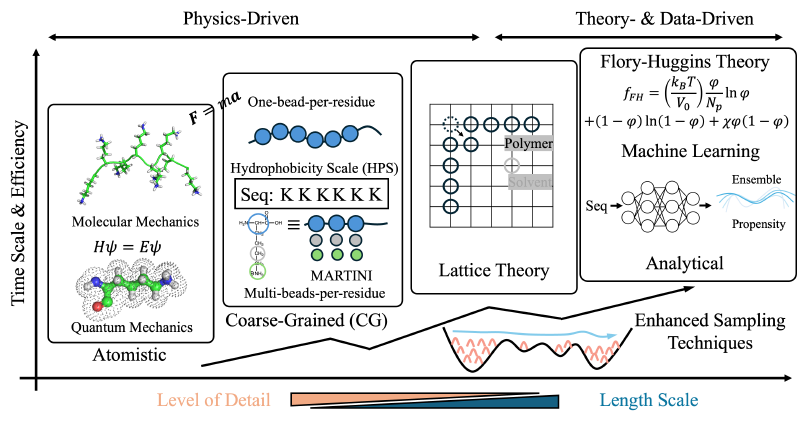
A coarse-grained model replaces groups of atoms with single interaction sites and asks what effective forces should act between them. There are two ways to answer that. The common one is top-down: pick a functional form, tune its parameters until the model reproduces a chosen experimental observable, and ship it. The other is bottom-up: derive the effective interactions from atomistic simulations of the same system, so that the coarse model inherits its parameters from a more detailed description rather than from a fitting target. We work on the second.
The appeal of the bottom-up route is that it is, in principle, systematic — force matching, relative-entropy minimisation and iterative Boltzmann inversion all define a well-posed thing to compute. The difficulty is that the object being computed is not a potential energy but a free energy: every degree of freedom that was integrated out leaves its entropy behind, folded into the effective interaction. That has a consequence people underestimate. A free-energy-derived potential belongs to the state point it was derived at. Change the temperature, the concentration or the composition and there is no guarantee it still applies.
This is where coarse-grained models quietly fail. A potential matched to single-chain structure need not reproduce multi-chain thermodynamics — matching the pair correlation function does not fix the pressure or the phase behaviour. Implicit solvent makes it sharper still: the solvent entropy is temperature-dependent, so the effective interactions are too, and temperature is exactly the axis along which phase diagrams are drawn.
Our interest is in both halves of that problem — deriving the interactions carefully, and then mapping the boundary of where they hold. A model that is honest about its own domain of validity is more useful than one that is slightly more accurate at a single state point.