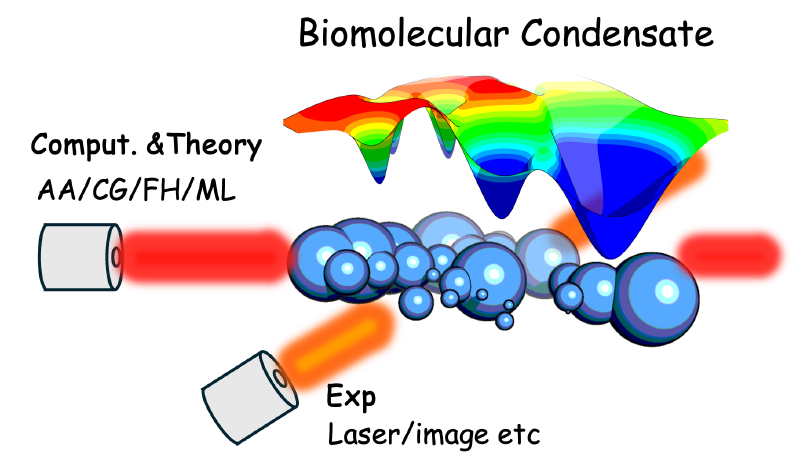
Background#
Cells organise a surprising amount of their chemistry without membranes. Stress granules, nucleoli and a range of other compartments form when proteins and nucleic acids demix into a dense phase — liquid droplets that concentrate some molecules and exclude others, assemble in seconds and dissolve just as quickly. When that process goes wrong, the same droplets can age into the solid, fibrillar material associated with neurodegenerative disease.
This sits squarely in the blind spot of all-atom simulation. A condensate is micrometres across and holds thousands of chains, and the demixing plays out over milliseconds to seconds. Explicit-solvent molecular dynamics, at its best, follows a handful of chains for microseconds. That gap is not something faster hardware closes: it is several orders of magnitude in both length and time.
Coarse-graining closes it by discarding what phase behaviour turns out not to depend on. Most condensate-forming proteins are intrinsically disordered, so there is no folded structure whose atomic detail has to be preserved — what sets the phase diagram is the pattern of charged, aromatic and hydrophobic residues along the sequence. A one-bead-per-residue representation with implicit solvent keeps exactly that pattern and drops the rest, and the saving is the difference between watching two chains touch and computing a converged coexistence curve from a slab of several hundred.
The point of that saving is not speed for its own sake. It is that the questions become the ones experiments actually ask. How far does swapping arginine for lysine move the saturation concentration? Which spacing of aromatic residues holds a droplet together, and which lets it dissolve? What does a disease-associated mutation do to the phase boundary? Every one of these is a scan across tens or hundreds of sequence variants — routine at residue resolution, hopeless atomistically.
What those answers are worth depends on the model underneath them, which is why this work runs alongside our coarse-grained model development: a phase diagram computed with a potential that was never tested away from its reference state point is a prediction with an asterisk on it.